
Beta for the first users · engine 0.4.0 · Studio 0.4.0
Noise studies you can defend
Attenix calculates road traffic, railways and industry exactly by the Dutch Omgevingsregeling, the RMG 2012 and CNOSSOS-EU. For every number it records how it was reached, down to the clause of the regulation.
Windows 10 or 11 (64-bit) · direct, no request needed

The 2026 noise map
The 2026 strategic noise map (geluidbelastingkaart) must be adopted by . Attenix takes the buildings, ground and terrain from 3D Geluid and the roads from a traffic model. It calculates by CNOSSOS-EU with the Dutch Bijlage XXXIII, counts the residents per class within the municipal boundary and assembles the delivery to RIVM. The export and its validation are checked against the documented Cvgg checks of the 2026 manuals.
What you do with it
Everything below is in the released engine 0.4.0 and Studio 0.4.0.
-
Road traffic
Bijlage IVe in its texts of 2024 and 2026-07, SRM II of the RMG 2012 and CNOSSOS-EU with Bijlage XXXIII. You take the roads with their traffic from a traffic model, a count or the noise register.
-
Railway and tram
Bijlage IVf in both texts, with steel bridges and the standing trains by Bijlage IVh, and CNOSSOS-EU rail with Bijlage XXXIII. Tracks with their train traffic come from the noise register or from a file of your own.
-
Industry
Bijlage IVh, model II.8 and method I, with LAmax, and CNOSSOS-EU industry. You draw point, line and area sources with directivity in Studio, or take them from an input file of the industry Rekenhart.
-
The noise map
From 3D Geluid and a traffic model to the delivery to RIVM: facade points, receiver grid and contours, and the dwellings and residents per class.
-
Assessment and measures
The level beside its limit, the sources that set the level at a group of receivers, and the effect of each screen. The engine calculates other screen heights exactly.
-
The calculation engine on the command line
The command-line tool
attenixis the calculation engine of Attenix, its rekenhart, as the Dutch field calls the program that calculates a level by the prescribed method. Studio calculates with the same engine; the tool also runs without Studio, on Windows and Linux. It is not RIVM’s program Rekenhart geluid.
Results that hold up in a review
A level you calculate ends up in a permit, a zoning plan or a noise map, and somebody will ask how it was made. Attenix is built so that the answer is written down before the question is asked.
Every run writes a manifest with the method edition, the implementation version, every setting and the digest of the input. Where a regulation is unclear, the reading Attenix chose is a numbered entry in a register. The same input gives the same number to the bit, on every supported platform.
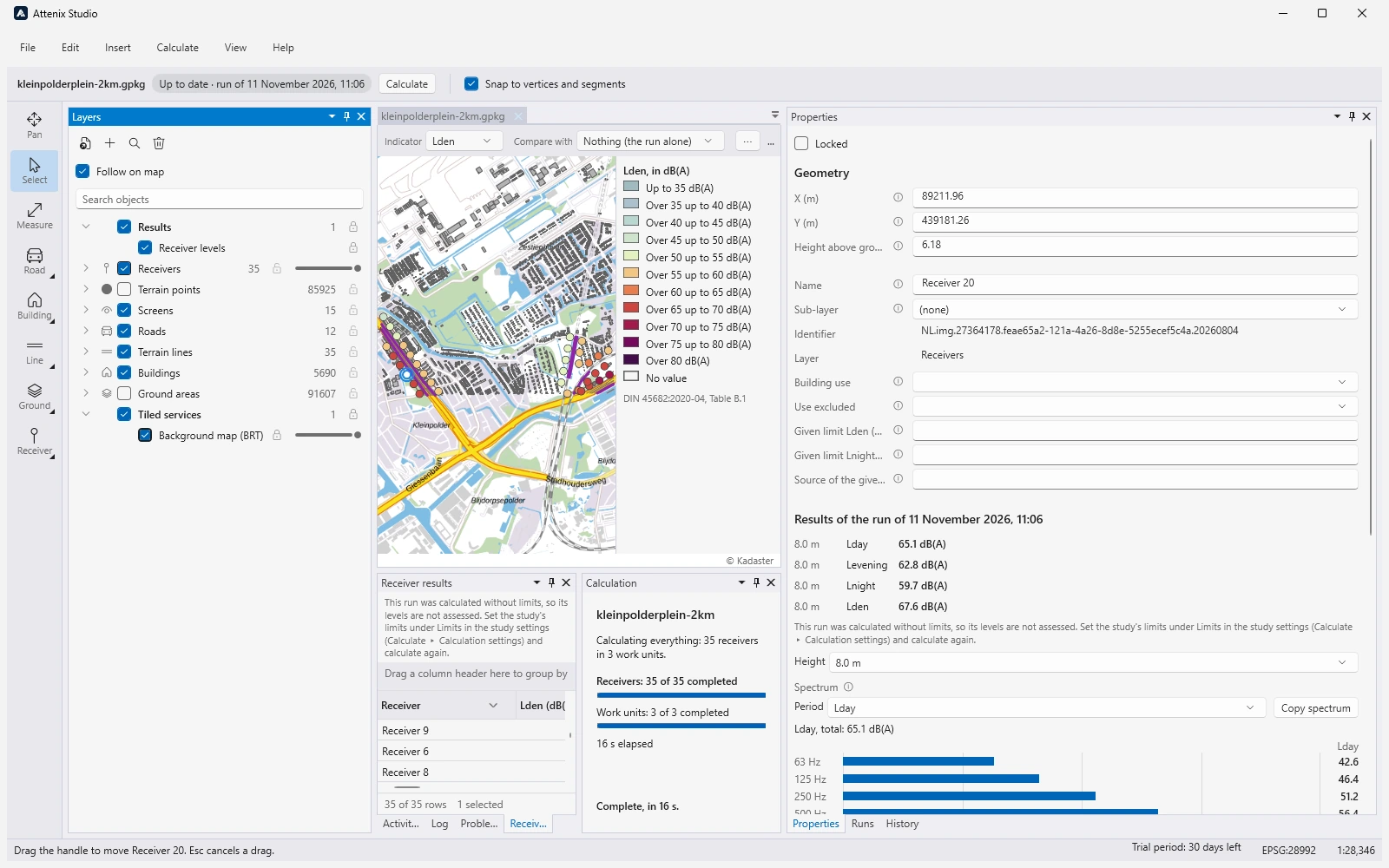
kleinpolderplein-2km: a receiver’s levels and the spectrum of its Lday. Background map: BRT, © Kadaster, CC BY 4.0; Studio 0.3.5, 2026-11-11.Check it yourself
- 56 of 56
- ISO/TR 17534-4 test cases for CNOSSOS-EU passed; the run holds for engine 0.4.0
- 3 source types
- road traffic, rail traffic and industry, each compared with RIVM’s Rekenhart programs
- 2 editions
- of Bijlage IVe side by side, the text of 2024 and that of July 2026: an earlier study can still be recalculated with the old one
- Compared with the Rekenhart: Attenix is compared with RIVM’s Rekenhart programs for road, rail and industry, on test scenes and on real neighbourhoods in Amersfoort and Nijmegen. Every difference above 0,1 dB is classified, and the defects found in Attenix this way are fixed. This is a comparison, not a conformity claim, and it implies no endorsement by RIVM.
- ISO/TR 17534-4: for every release Attenix calculates the ISO/TR 17534-4 test cases for CNOSSOS-EU propagation. The cases themselves are not public; the outcome of every run is recorded. How the results are checked
- Recalculate it yourself: the noise-map example is made from open data only: 3D Geluid, the Provincie Utrecht’s traffic volumes, the BAG and CBS Wijken en buurten. The example and its data
- The developer: the team behind Acrotron has extensive experience supporting the US government with its noise modelling software. Acrotron is listed as a developer in the public technical manuals of FAA AEDT. Who makes Attenix
Where Attenix stands
Engine 0.4.0 and Studio 0.4.0, of , are beta releases for the first users. A release for general use, the terms and the prices are not yet announced.
Attenix is still in beta. A lot can still change between releases: the functions, the interface, the file formats and also the results, as the implementation of a method is refined. We would like to hear from users what works, what does not and what is missing: info@acrotron.com.
Frequently asked questions
Can I use it for a study I hand in today?
Engine 0.4.0 and Studio 0.4.0 are beta releases for the first users. Use them to try Attenix on your own studies and compare it with the program you use now, and tell us what you find. A release for general use is not yet announced.
Can I bring my existing models?
A study is a GeoPackage, which GIS software opens and writes. Models in the QSI data interface of DIN/TS 8998-1 are imported with their receivers, buildings, screens, terrain and ground areas; sources come as geometry only, since QSI has no supplement for these methods. The command-line tool makes a study from an input file of the Rekenhart geluid, for road or rail traffic, or of the industry Rekenhart, and from the IMGeluid files of the noise register; Getting started shows how.
Who makes Attenix?
Acrotron, since 2017. The team behind Acrotron has extensive experience supporting the US government with its noise modelling software, including FAA AEDT and FHWA TNM. For management sums up what that means, and what happens to your data and calculations.
What does it cost?
Licensing and prices are not yet announced.
Your contact person is in Zeist
Attenix is developed in Zeist, in the Netherlands, which is also where your contact person is. We are glad to show Attenix on your own data, help you with a trial and discuss the methods and the readings in the registers.
Tell us which methods you calculate and how large your studies are, so that we know what matters to you.
Write to info@acrotron.comRead further
-
Getting started
From the example that comes with Studio, a Rekenhart file or open data to a first calculated study.
-
Videos
A three-minute overview and eleven short videos, from building a study to delivering the noise map and calculating on several computers.
-
For management
A summary to pass on: who makes Attenix, what happens to your data and why the results stand up to a review.